Mirrors and doubles
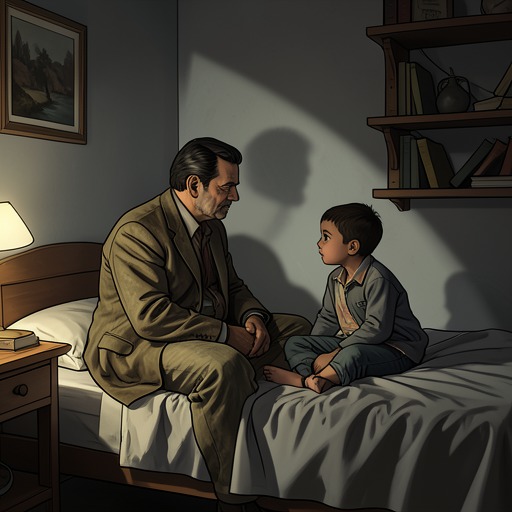
A ManMirrors and doubles are the novel’s central structure for thinking about identity, storytelling, and the desire to enter another person’s life. X had abandoned his former identity and lived as Daisuké Taniguchi; Kido, drawn into the story, briefly performs that borrowed identity himself. Above them, the frame narrator watches Kido absorbed in his pursuit. Each figure becomes at once a person and a reflection through which another tries to understand what a self is.
A story of backs and reflections
The novel’s prologue makes the doubling explicit through René Magritte’s painting Not to Be Reproduced: a man faces a mirror, but sees the back of another version of himself, which in turn seems to look into the depths of its own reflection. The frame narrator compares the story to this recursive image. Kido is not simply the protagonist because of the unusual events he encounters; he matters because of the way he looks at the life of another man. The narrator, in turn, attends to Kido’s absorption in that pursuit. The story’s reflective structure therefore extends beyond its characters to the act of telling: the artist watches the lawyer who watches the man he is trying to understand.
That structure also unsettles the distinction between an original and a copy. Kido’s pursuit is directed toward X, a man whose life had already been lived under someone else’s name. Yet the prologue’s image does not offer a secure original beyond the reflections. The man seen from behind cannot be read straightforwardly as a complete, knowable self; each figure is apprehended through another’s view. The motif gives formal shape to a question the plot keeps testing: whether someone can be understood apart from the stories through which others recognize him.
Borrowed identities and the limits of recognition
Kido’s thoughts about Kaori and Rié’s late husband give this question an intimate dimension. He recognizes that he could have accepted a stranger’s life story as Kaori’s own and built his understanding of her around it. The past conveyed in words is not the past itself, and a listener cannot compare every account with the life it claims to describe. Kido imagines that contradictions might become visible through contact with people who knew the person before—but that safeguard disappears if someone has cut off family and friends. He believes Daisuké Taniguchi avoided social media in circumstances that made his past difficult to verify.
The correction Kido makes to himself is decisive: Rié’s husband was not Daisuké Taniguchi, but X, who impersonated him. The name does not resolve the problem of identity; it marks the point where Kido’s knowledge has to distinguish the man from the identity he inhabited. X’s borrowed life had become sufficiently real to Rié that she loved the person before her, while the truth of his name remained concealed. The gap between lived relationship and verifiable biography is not merely a trick in the plot. It exposes how much recognition depends on trust in a story that cannot be completely checked.
Kido’s resulting fixation is itself a kind of reflection. Ever since Rié told him about X, the man has haunted Kido in the midst of ordinary activities: walking, riding a train, or eating with his family. The repeated return of X’s life in Kido’s thoughts makes the other man less a solved case than an image that has entered Kido’s own daily experience. His effort to understand X increasingly reveals what Kido cannot explain about himself.
Kido’s enactment of another life
In a bar in Miyazaki, Kido moves from imagining X’s impersonation of Daisuké to performing it. A bartender speaks of his family’s construction business and of his elder brother taking it over; Kido responds by giving his name as Daisuké Taniguchi. The bartender accepts the introduction without doubt and gives Kido his manager’s card. A small exchange creates the possibility of local recognition: Kido thinks that if they crossed paths again, they would probably nod to one another. The assumed name begins to produce an ordinary social bond, not just a concealed past.
Over another glass of Stalinskaya, Kido recounts Daisuké’s history as though it were his own. He speaks detachedly about agreeing to become an organ donor and about the resulting, irreparable break with his family, smiling ruefully as he goes. The story is a performance, but Kido scarcely experiences it as one. Instead, speaking the borrowed past seems to bring him closer to unity with it. The bartender responds with measured sympathy, and Kido feels he could continue until he drank himself into tears. A fabricated identity thus does not remain external to the person who adopts it: the words carry an emotional force that Kido experiences as his own.
The episode leaves him with what he calls an inexpressible joy during the two hours he impersonated X. Nervous, excited, and dizzy, Kido compares the experience to the effect of tragedy, but imagines a new kind of hobby in synchronizing himself with another person’s life story and inhabiting that person’s inner world vicariously. He also calls the game shameless and bitter in its aftertaste. That qualification matters: the experience offers a form of closeness, but it does not grant Kido the life, history, or knowledge that would make him X. The pleasure depends on an act he knows is false, and its emotional intensity does not make the past his own.
Even after returning to Yokohama, Kido wants to become again the self he had left downtown that night: the continuation of X’s life as Daisuké. But he does not return to the bar. The next day, seeing Rié distressed again by the truth about her husband, he feels guilty for enjoying his masquerade. He also has almost nothing left to say as Daisuké. The temporary identity has generated a pull toward repetition, then met an ethical limit in the suffering of the person most affected by X’s deception.
The double as a test of love and selfhood
Kido cannot fathom why X threw everything away. He feels a vague jealousy of that apparent capacity for rupture, because however weary he grows of his own life, he cannot simply discard it. His recurring thought of his son enjoying the outdoor hot spring bath at the Sheraton gives that inability a concrete counterweight: his attachments still make the life he has difficult to abandon. In imagining X’s former life, Kido wonders whether it held comparable joys, or whether X rejected it along with the family bound to it. He sees a possible parallel with Daisuké, who cast off his past to separate himself from his family, giving up even the possibility of hating them from a distance. X’s adoption of another past might have offered some kind of redemption, but Kido cannot know whether it did.
The second mystery is X’s continued deception of Rié. Kido regards the love between them as more beautiful and pure than any love he has known, while confronting the fact that it grew within a relationship founded on a false identity. He wonders whether X intended eventually to confess, and whether the lie itself helped Rié respond with compassion after the pain she had endured. Even if the rest of X’s account was false, Kido cannot settle whether the moment when X might have spoken honestly could have absolved the lie, or whether their later love can give the deception meaning. The questions do not erase the betrayal; they keep the original and the assumed self in unresolved relation.
The motif’s force lies in that unresolved doubling. X’s one life seems to have contained two lives, as he left the first behind and began a new phase as the second; Kido then repeats a fragment of that transformation without becoming X. The prologue adds another reflection, as the narrator makes Kido’s absorption into the subject of the story. Each act of looking brings another person closer, yet none supplies an unmediated, final self. The novel’s mirrors therefore do not promise that another life can be fully possessed. They show how the attempt to recognize or inhabit another person can alter the observer, while leaving the difference between them intact.